
DETECTORS
Federico Luger Gallery (Milan)
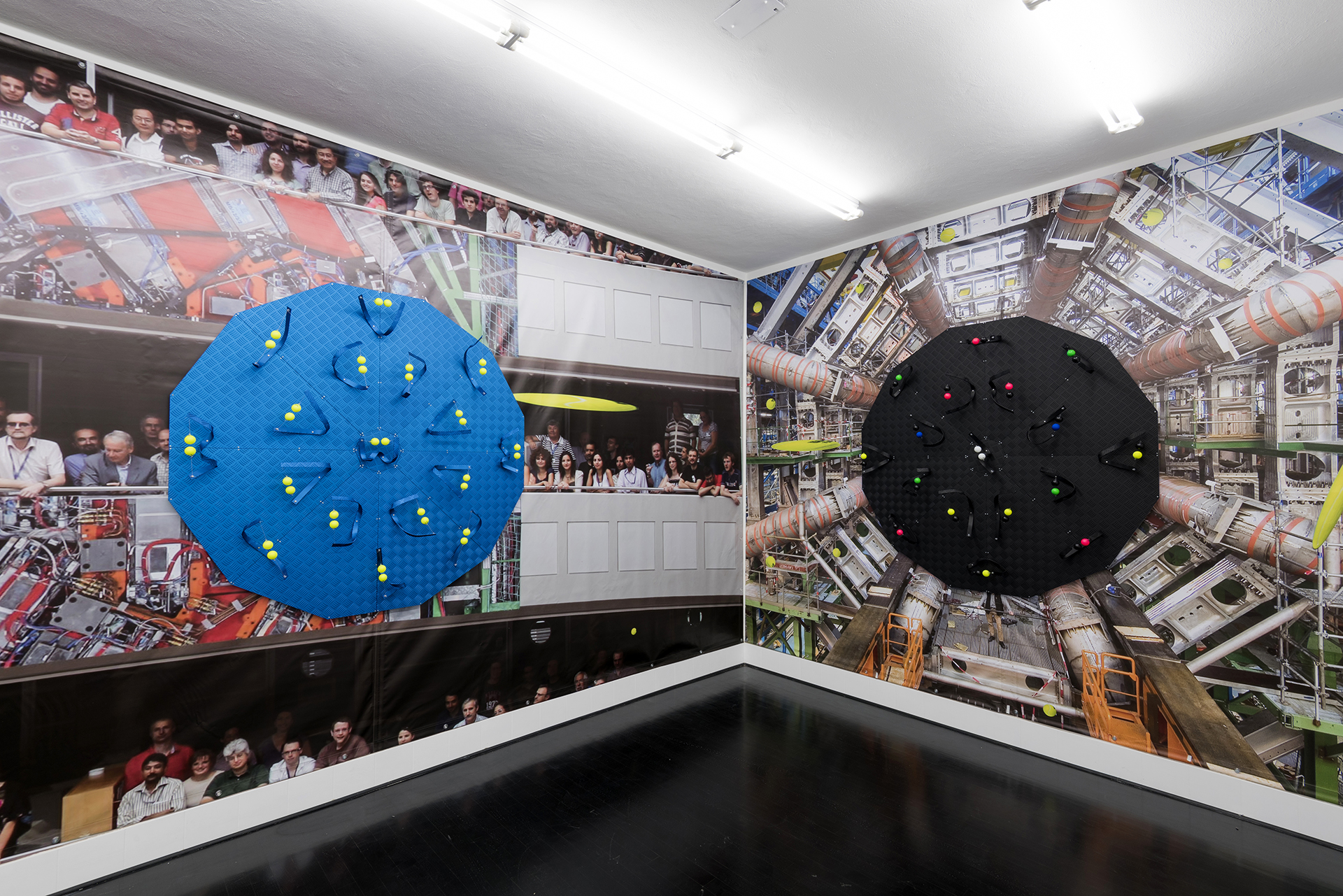
In a landmark collaboration with the CMS Experiment at CERN, Luca Pozzi presents “Detectors,” an exhibition conceived as a visionary celebration of the 13 TeV collision energy achieved by the Large Hadron Collider at Federico Luger Gallery in Milan. Dedicated to Fabiola Giannotti, this site-specific project transforms the gallery space into a high-energy laboratory where the boundaries between human history and subatomic exploration dissolve. By utilizing the former vault of Spazio 22, Pozzi creates an environmental installation where giant digital PVC prints—sourced from the LHC’s online archives—entirely wrap the walls, effectively substituting the museum’s skin with the scale and aesthetic of particle physics apparatus. The exhibition plays on a sophisticated temporal and perceptual ambiguity. On the right, a view of the ATLAS detector during its construction phase anchors the viewer in the “past” of the experiment. To the left, a graphical display of computerized data from the ALICE detector represents the “present” processing of a collision. Finally, a twelve-meter-long photograph of the CMS community serves as a window into the “future,” welcoming the public into the tireless research environment of Building 40 in Geneva.
Within this network of relationships, Pozzi introduces the “Detectors” series: four dodecagonal surfaces of anodized aluminum containing thirty ping-pong balls held in magnetic suspension. Using the sportive allegory of a ping-pong game, these pictorial devices capture the “particle” of the beam a fraction of a second before impact. This cross-disciplinary approach blends Pozzi’s fascination with masters like Lucio Fontana, Alberto Burri, and Enrico Castellani with the speculative wonders of quantum gravity and the digital revolution born at CERN. “Detectors” is not merely an exhibition of images; it is a conceptual bridge where the most ambitious machine ever built by humankind becomes a tool for artistic revelation.
DETECTORS


