
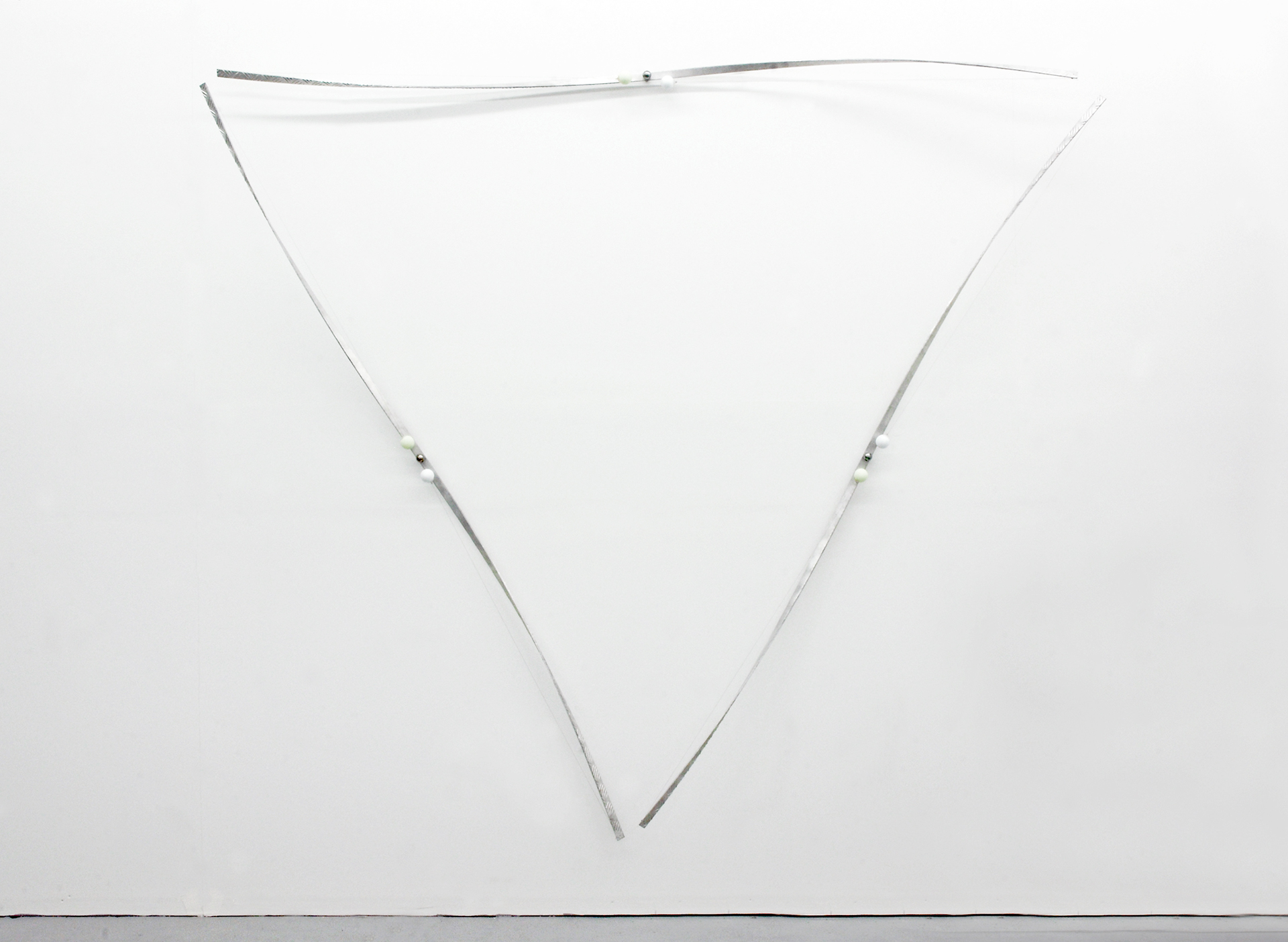
The Integral Triangle
Magnetic Pull System
The Integral Triangle, composed of three almond-patterned aluminum bars—each 250 cm long—mounted on the wall, form a perfect equilateral triangle. This structure is not merely an homage to Platonic stability, but also a device engineered to make quantum tension tangible.
At the center of each bar, a spherical magnet exerts a constant pull on two ping-pong balls. These spheres are constrained by a taut thread connected to the poles of each module, but with a crucial technical detail: the length of the thread is deliberately shorter than the distance required for physical contact between the ball and the magnet. The result is a locked oscillation, where the ball remains suspended in mid-air, floating in a magnetic equilibrium that defies the perception of gravity.
The work is deeply inspired by Richard Feynman’s Path Integral formulation. In quantum mechanics, this concept suggests that a particle does not follow a single trajectory between two points, but simultaneously takes every possible path. Pozzi’s triangle thus becomes a macroscopic representation of this principle: the suspended balls embody the wave function, a probabilistic entity containing all potential directions before the observer fixes its position through decoherence.
From the perspective of Loop Quantum Gravity, the three aluminum segments represent the edges of a spin network, the discrete backbone of spacetime.
In this installation, the void at the center of the triangle is not an absence, but an informational field of forces. The suspension of the ping-pong balls suggests that reality itself is “held together” by non-local relationships and invisible energy exchanges. The Integral Triangle transforms the gallery wall into a three-dimensional Feynman diagram, where the artistic gesture slows down the collapse of the wave function, allowing the spectator to inhabit, if only for a moment, the threshold between the possible and the real.
The Integral Triangle

To get information on available Artworks, Commissions, and Collaborations:
